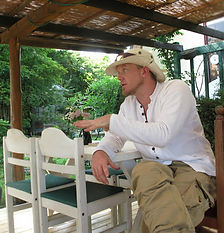
"Based on deep ecological principals, we look to design and build spaces that integrate nature with the built environment. Walls as an interface with the sky, not a border to block it. Homes that grow stronger over time like the roots of a tree. Modern living defined by the simplicity of ancient design wisdoms." Jacob Reiner
Selected Works
Sustainable property developer, architectural designer and deep ecologist Jacob Reiner specializing in luxury home design, modular housing systems, rural revitalization, village development, food security and integrated agri-resort projects. His design approach emphasizes natural materials, passive environmental systems, and the integration of architecture with landscape, agriculture, and community use. The central theme of his building design and community planning is creating environments that support local food production and restore the social and economic benefits of traditional village life. His work spans across the globe, from Japanese traditional village restorations to ski lodges in the Rockies to mushroom production facilities in Bangladesh.
Education
Cornell University
Salzburg College
Acadia Institute of Oceanography
Works
New York, Japan, Hawaii, British Colombia, Bangladesh, New Jersey, California

MODERN PUEBLO プエブロ
The Pueblo is a traditional building style of Arizona and New Mexico in which a single structure functions as an entire village—the word “pueblo” meaning house, family, and community at once. This idea is the inspiration and working model for my modern homes: layered architecture that integrates dwellings, workspaces, and communal gathering areas into a solid, expandable core designed to support shared resources and collective life.
In architectural design, we have both the opportunity and responsibility to create homes that provide sustainable shelter, safety, food, and comfort for our children—and for the seventh generation. Each design is informed by this ethic, integrating passive solar heating, naturally cooled interior zones, food production systems, and shared spaces that embed a village lifestyle directly into the architecture itself.


古民家 JAPANESE TRADITIONAL KOMINKA
In the mountain valleys of Japan, beautiful handcrafted wooden homes sit quietly—many vacant and in need of renewal. Years ago, we discovered a small hamlet near the lakes of Mt. Fuji and began restoring these houses one by one. Each project carefully integrates modern comforts—insulated glass windows, true wood-burning chimneys, radiant heated floors—while preserving the integrity of the original structure. Using local timber, regional craftsmen, and creative reuse of historic materials, we transform each home into a distinct work of art and help revive village life by welcoming new residents back to the community.


Modular モジュラー
These highly efficient buildings use a flexible frame-and-panel system that allows a wide range of finishes—fine wood, natural stone, concrete, or high-performance composite panels—without altering the core structure. The result is a resilient architectural system that balances structural integrity, design freedom, and cost control.


Agri Tech - Smart Farms スマートファーム
The ATOM FARM series is a modular smart growing system designed to bring reliable food production to homes, restaurants, urban sites, and small farms. It includes compact indoor growing units, weather-proof micro-farm modules, and expandable solutions such as mushroom cultivation systems, greenhouse cubes, and agricultural units scaled for commercial use. These systems allow year-round production of fruits, herbs, vegetables, and specialty crops in controlled environments, making fresh, high-quality food accessible close to where people live and work.
Designed to integrate with sustainable living frameworks like ATOM HOUSE, the ATOM FARM series supports a “home-to-table” lifestyle where food growing, water management, and energy systems coexist within a resilient modular architecture. From compact indoor units for homes to larger container-based systems for small farmers and commercial operations, the series emphasizes adaptability, modular expansion, and efficient food production in diverse climates and urban contexts.


Villages
My design philosophy reinterprets the traditional village as a model for modern living—one that integrates food, water, energy, and community into the built environment. It embeds regenerative farming, agroforestry, and permaculture-based fruit systems directly into residential and mixed-use developments, whether in agri-resorts or urban high-rise farms. These landscapes are not ornamental but productive, supporting local food systems and enabling on-site value-added production. Passive solar housing, building-integrated greenhouses, and energy cogeneration systems further align architecture with natural cycles, reducing dependency on external resources while enhancing resilience and comfort.
In contrast to isolated suburban sprawl or disconnected urban towers, this approach restores the village as a cohesive, living system. Community planning emphasizes shared infrastructure such as solar energy networks, walkable layouts, and spaces that support intergenerational care and collaboration. By integrating ecological design with modern technology, these environments become self-sustaining and socially connected—places where production, habitation, and community life are interwoven, and where residents actively participate in the systems that support them.


URBAN
Our modern cities are built on top of former farms. Manhattan itself supported sheep and cattle little more than a century ago, yet today food production has been pushed far beyond the urban edge. In its place, cities have become centers of consumption, disconnected from the land systems that sustain them. My work restores that relationship by reintroducing agriculture directly into the fabric of urban life—through high-rise farms, rooftop growing systems, agroforestry corridors, and building-integrated greenhouses. The aim is not to romanticize the past, but to evolve it: to create a pastoral urbanism where fresh food, clean energy, and ecological cycles are visible, local, and part of everyday experience.
This vision draws on the idea of the commons—shared resources that are collectively stewarded for the benefit of all. In traditional villages, land, water, food systems, and knowledge were often managed as a commons, fostering resilience, accountability, and community cohesion. In the modern city, we reinterpret this through shared growing spaces, distributed energy systems, local processing, and cooperative infrastructure that returns value to residents. The result is a healthier, more connected environment grounded in regenerative practices and resource responsibility. We implement this through a combination of pre-designed modular systems, in-house research and development, and close collaboration with industry and manufacturing partners—scaling solutions that are practical, repeatable, and adaptable to diverse urban contexts.


Background and Experience
Jacob Reiner is a sustainable property developer, architectural designer and deep ecologist specializing in modular housing systems, rural land development, food security and integrated agri-resort projects. His design approach emphasizes natural materials, passive environmental systems, and the integration of architecture with landscape, agriculture, and community use. The central theme of his building design and community planning is creating environments that support local food production and restore the social and economic benefits of traditional village life. His work spans across the globe, from Japanese traditional village restorations to ski lodges in the Rockies to mushroom production facilities in Bangladesh.
A passion for ecological design began in childhood growing up on 100 acres of forest in the eastern Maritime provinces of Canada, where his parents built their first home—a traditional tipi—when he was three years old. The family’s drinking water came from a small bubbling spring, the kitchen was a simple outdoor wooden bench with a roof, and the nearest electricity or telephone was five miles away through the woods at a neighbor’s house. Daily life was closely tied to the surrounding ecosystem—fishing for trout in the nearby river, watching beavers shape ponds through the forest, and gathering wild blueberries each summer. From an early age he participated in building and farming, planting seeds in the garden and helping his father wind the long poles that formed the tipi structure. These early experiences formed the foundation for a lifelong career focused on ecologically balanced living and building.
Jacob began building in earnest with a carpentry apprenticeship at age fourteen in upstate New York, working on historic New England farmhouses and country estates. Over the next decade he developed hands-on experience across the building trades, learning everything from pouring foundations to wiring and repairing slate roofs while self training in architectural design and construction engineering. He attended Cornell University receiving a Bachelors of Science degree in Natural Resources with a minor in environmental education, with summers spent on construction sites. His work later took him to building sites in Maui, Hawaii; Whistler, British Columbia; Japan; and other international locations. This early immersion provided practical construction knowledge and exposure to diverse building environments and techniques.
In 2000, recognizing that demand for sustainable housing existed but consumers lacked clear ways to access ecological building solutions, Reiner founded Earth Embassy, an organization focused on developing sustainable homes and small farm tech through the construction of agri-resorts, boutique farms, and local food businesses with value-added products. He also established the Earth Embassy Sustainable Living Center, which hosted international students and post-graduate interns studying organic farming, product development, and renewable energy systems at the Fuji Farm & Solar Café, a working organic farm and restaurant, and launched the Mt. Fuji Mint Tea Company using locally grown herbs and forest products..
In 2006, Reiner founded EDEN Homes in Japan, a design-build and real estate development company focused on rural communities and adaptive reuse of traditional buildings. A landmark early project was the restoration of a traditional minka village at Lake Shojiko near Mount Fuji, where he acquired, restored, and resold historic homes and abandoned structures. The project brought over $1 million in investment into the local community, helped preserve traditional architecture, and received government grants and international media coverage including the Wall Street Journal, International Herald Tribune, and Washington Post.
Reiner has also held consulting, design, and project management roles with international firms including WeWork and Honka Homes, and has lectured at and collaborated with institutions such as the University of Tokyo, Nippon Veterinary and Life Science University, and Peace Boat.
As lead designer for ATOM, Reiner developed modular housing and agricultural systems platforms. ATOMHOUSE focuses on prefabricated, globally deployable housing, while ATOMFARM develops scalable food production systems including controlled-environment agriculture and mushroom cultivation technologies. The group has also worked on advanced strawberry and wasabi systems in Japan. ATOM has received multiple grants for R&D in low-energy heating and cooling systems using Stirling engine technology, and has delivered international agricultural infrastructure projects, including a government-supported mushroom production facility in Bangladesh.
Together these projects reflect Reiner’s continuing focus on modular architecture, integrated agriculture, and manufacturing systems that support sustainable communities worldwide.

With a focus on sustainable lifestyle and cutting-edge technology, we revolutionize the way resorts are designed, constructed, and lived in.
Architectural Design and Planning
Modern beauty, traditional comfort and smart efficiency.
Real Estate & Property Development
Project management from planning to completion.
Hotel & Farm Operations
Green homes with integrated food-growing systems.